
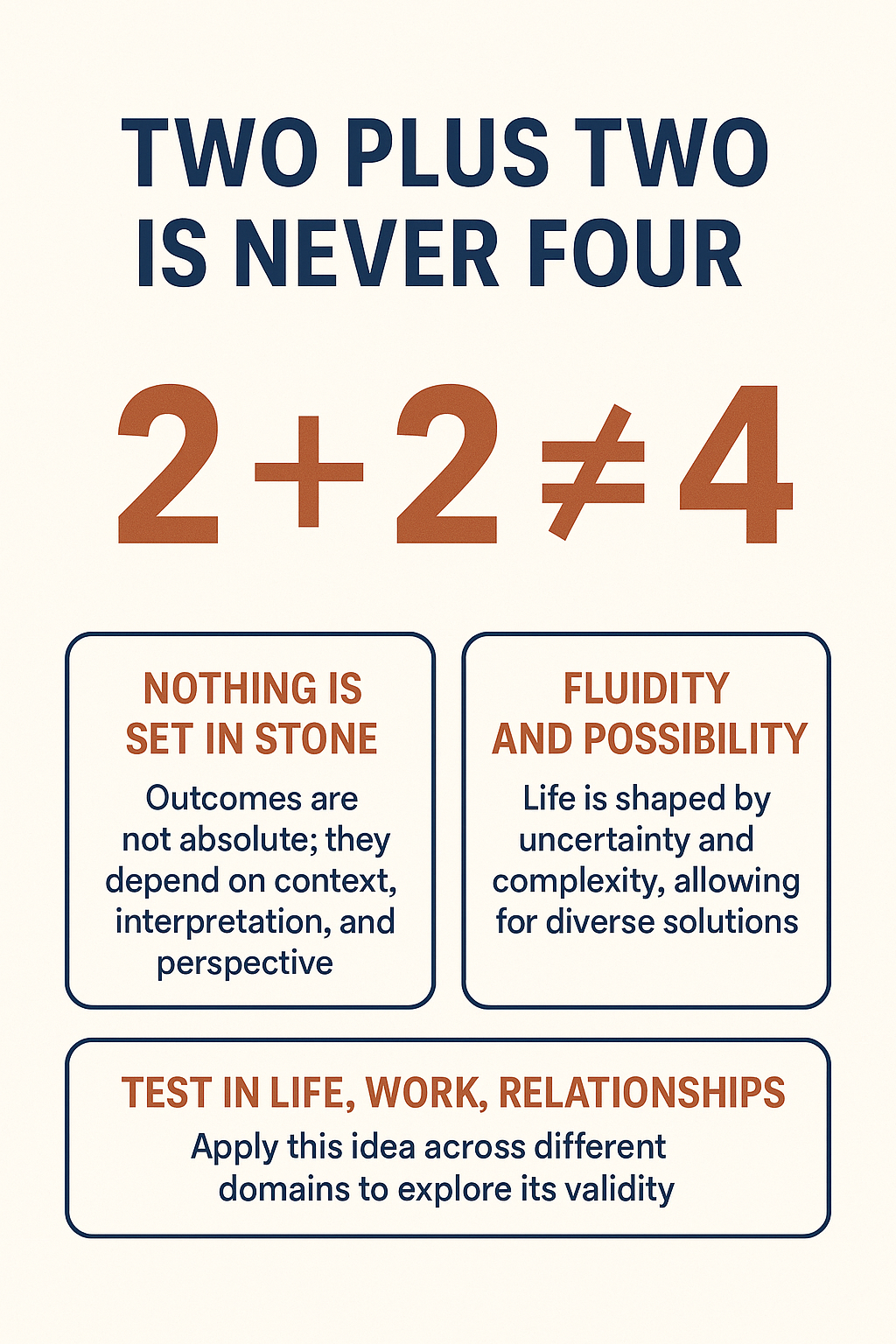
Take a strategy that worked brilliantly. Copy it exactly — same product, same price, same pitch, same people. Launch it again somewhere else, or simply eighteen months later. Watch it fail.
Nothing in the strategy changed. That is precisely the problem.
The same decision, taken in two different contexts, can produce radically different outcomes. Models do not usually fail because they are wrong. They fail because the context moved and the model did not. The formula stood still while the world walked away from it.
In 2+2 Is Never 4 I describe variables as living in nested layers — local, industry-wide, global, temporal — and argue that knowing at which layer to look determines whether your analysis is useful or decorative. Most of us only ever look at one.
Local. Your team, your street, your client’s mood this week. The layer you can touch, and therefore the one you overestimate.
Industry-wide. The conventions of your sector — the rules everyone follows so faithfully that nobody remembers who wrote them.
Global. Energy, regulation, geopolitics, the temper of an entire economy. The layer that arrives without asking permission.
Temporal. The moment itself. The same offer made in January and in June is not the same offer. What looks insurmountable today may dissolve tomorrow — and what worked yesterday may already be expired.
None of these appear in a template. All of them decide the result.
The good news is that reading context is not a mystical talent reserved for a gifted few. It is a discipline, and disciplines can be learned. It begins with a simple habit: before asking what should we do?, ask what has moved since the last time this worked?
But I want to be careful here, because this idea has a shadow. If context explains everything, it can also excuse everything. The market changed is sometimes an insight and sometimes an alibi. Context is a lens for seeing more clearly — not a place to hide from responsibility. The manager who reads context well does not say it was not my fault. They say I should have seen it move, and next time, they do.
That is the humble and the empowering half of the same truth. Humble, because you do not control the variables. Empowering, because you can learn to see them coming.
Your spreadsheet tells you what you counted. The world answers with everything you didn’t.
2+2 Is Never 4: There Is Always a Way — live presentation on 28 October. [VENUE · TIME · REGISTRATION LINK]
Leave a Reply