
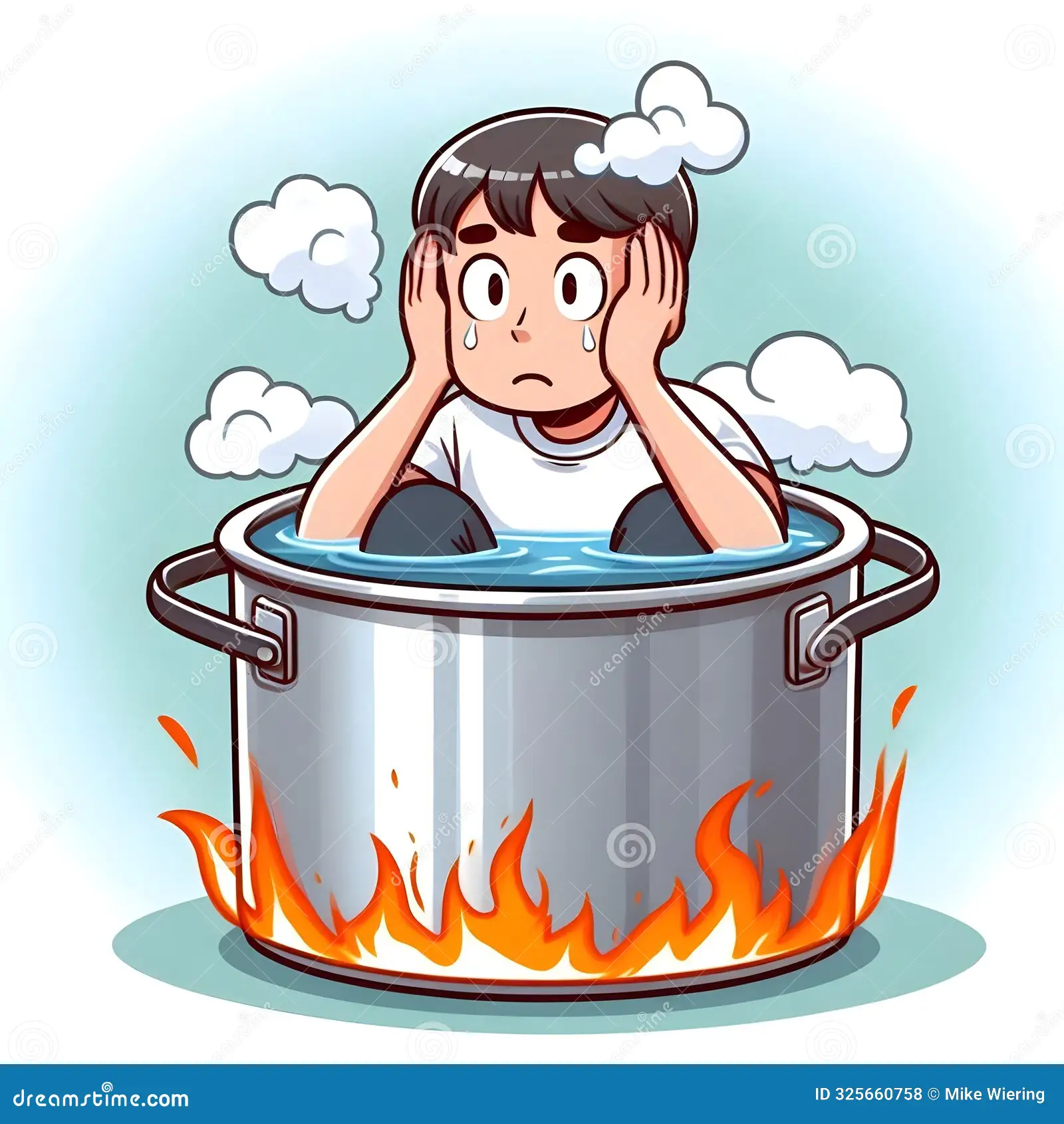
You know the frog story. Drop it in boiling water and it jumps out immediately — the shock saves it. Put it in cool water and raise the temperature one degree at a time, and it stays. It adjusts. It never finds the exact moment worth jumping for, because no single degree ever felt like the one that mattered. It is a myth, biologically — real frogs jump. But we are not real frogs. We are the version the story was actually written to warn.
Or take the other image, the one I like better because it is not a myth: a duck on a pond. From the bank it looks serene. Gliding. Barely a ripple. Underneath the waterline, out of sight, the legs are working constantly, just to stay in place, just to keep from drifting backward. That is not peace. That is exhausting, invisible effort dressed up as calm, because calm is what we have decided to perform for each other.
I think that is where most of us actually are right now. On the surface: fine. Getting on with it. Underneath: paddling like hell, and quietly accepting things a decade ago we would have called unacceptable.
What we have quietly signed off on
Taxes have gone up, in one form or another, in most places most of us live. Prices have gone up faster than wages have, for long enough that we now call it “the new normal” instead of what it is. Laws get stricter, the permissions get narrower, the paperwork gets thicker, and each individual change is small enough to shrug at. And politicians — across the spectrum, in country after country — say things that do not survive contact with basic scrutiny, and mostly we let it go by. Not because we believe them. Because responding to all of it, every time, is exhausting, and we have already spent that energy just staying afloat.
I wrote on this blog not long ago that a society does not collapse because it becomes inefficient. It collapses because enough people quietly stop believing the rules are fair — and that erosion does not happen all at once. It happens one degree at a time, until one day it is simply gone and nobody can point to the exact moment it left. That is not a metaphor anymore. That is a description of where a lot of us actually are.
We stopped swimming together
Here is the part that worries me more than any single price increase or any single bad law: we used to do this together, and we do not anymore. Collective response — the union, the neighbourhood, the genuine public outcry that actually changed an outcome — has been quietly replaced by an individual scroll, an individual complaint typed into a box that algorithmically rewards outrage and does nothing with resolve. We are angrier than we have ever been, and less organised than we have ever been, and I do not think that is a coincidence. A culture that rewards the loud, simple, shareable reaction over the slow, coordinated, unglamorous kind of pressure will always end up with people who feel furious and alone at the same time.
So we have accepted something underneath the specific grievances: that we are on our own. That nobody is coming. That the only rational move left is to manage your own little pond as well as you can and stop expecting the water level to change for anyone else.
I understand the logic of that retreat. I do not accept the conclusion.
The difference between calm and surrender
Paddling to stay in place is not the same thing as paddling somewhere. That is the actual problem with the duck, and with us. The effort is real. The direction is missing. Most of what passes for resistance right now — the comment, the repost, the five minutes of outrage before the next video — is exactly that: energy spent keeping our heads above water, not energy spent getting anywhere.
We do not need more paddling. We need the same amount of effort pointed somewhere on purpose. And the place I think it has to start, because it is the one lever every single one of us holds every single day without needing permission from anyone, is the decision. What we buy. What we support with our money and our attention. What we walk past instead of purchase out of pure habit or pure want.
Logic and control are not luxuries. They are the job.
I have said before on this blog that productiveness and usefulness are close to the only obligation I actually believe in. I think logic and control belong right beside that obligation, not underneath it. Every purchase made on pure desire instead of actual need or actual value is a small vote cast for the exact system we are complaining about — the one that profits more when we react than when we think, that prices in our impulse, that has learned our patterns better than we have.
Deciding on logic is not about becoming joyless or cheap. It is about reclaiming the one variable that is actually still ours: the choice itself. Where the money goes. Which company gets rewarded for its behaviour and which one does not. Which habit we keep because we genuinely value it and which one we keep only because stopping would take more attention than we have been willing to spend. That is not a small thing. Multiplied across enough people making the same deliberate choice, it is the only kind of pressure left that does not depend on anyone else showing up first.
This is our right, because nobody can take the inside of our own decision-making away from us. And I think it is also our obligation, because the alternative — drifting on desire, letting the current set the direction — is exactly how we ended up accepting all of it in the first place, one small comfortable decision at a time.
Be a soldier of this
Two hundred and fifty years ago, in the middle of a war that looked unwinnable, Thomas Paine wrote the line that outlived every battle from that campaign: “These are the times that try men’s souls. The summer soldier and the sunshine patriot will, in this crisis, shrink from the service of their country; but he that stands it now, deserves the love and thanks of man and woman.” He was not writing about a comfortable, sunny kind of commitment. He was writing about the kind that shows up when it costs you something — when it would be easier, and cheaper, and quieter, to just keep paddling in place.
I am not asking anyone to storm anything. I am asking for something smaller and, I think, harder to sustain: be a soldier of your own logic. Notice the temperature instead of adjusting to it without comment. Make the purchase, the vote, the daily decision on reason instead of on impulse, on principle instead of on convenience, even when nobody is watching and nothing about it will trend. Do it especially then.
We will not fix the water level by being calm about it. And we will not fix it by paddling harder in the same spot. We fix it, if we fix it at all, the way every real change has ever actually happened: one person deciding that this decision, right here, will be made on logic and not on drift — and then doing that again tomorrow, and the day after, until enough of us are doing it at once that it stops being a private discipline and starts being a current of its own.
Ricardo Jovani teaches Crisis Management, Operations & Supply Chain, and Family Business Management at Geneva Business School Madrid. He is the founder of Jolufoods S.L., author of The TriCore Method and the forthcoming 2+2 Is Never 4, and a TEDx speaker. These are his own views — and he is willing to defend every one of them.
Leave a Reply