
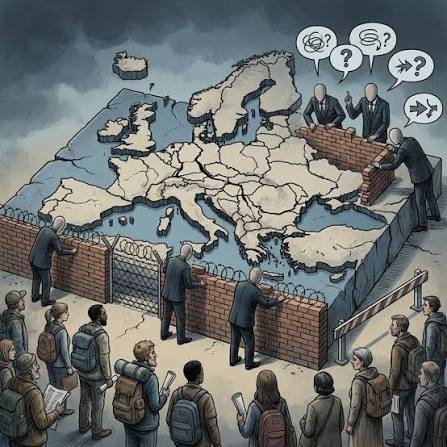
There is a difference between losing and surrendering.
Losing implies you were outcompeted. That someone was faster, smarter, more resourceful. That the game was played and you came second.
Surrendering is different. Surrendering is what happens when you stop playing because playing became uncomfortable. When the pursuit of relevance is quietly replaced by the management of its absence. When the institutions that were built to lead begin spending their energy explaining why leadership is no longer their responsibility.
That is where Europe is. Not losing. Surrendering.
And the most troubling part is that most of the people responsible for it have convinced themselves they are being sophisticated.
The geopolitical disappearance
There was a time when Europe was not simply present in the geopolitical conversation — it shaped it. European frameworks, European standards, European moral authority carried weight in rooms that mattered. The continent had earned that position through centuries of hard experience, catastrophic mistakes, and the genuine wisdom that emerged from surviving them.
That position is gone. Not stolen. Abdicated.
When the defining conflicts and alliances of our era are being drawn — in Ukraine, in the Middle East, in the South China Sea, in the corridors of trade negotiation between Washington and Beijing — Europe is largely a spectator. Occasionally a commentator. Rarely a protagonist.
The response from European leadership has been to produce statements. Frameworks. Declarations of concern. Documents with signatures attached to principles that carry no force because the will to enforce them was never part of the agreement.
The world has noticed. And the world has moved on accordingly.
The geoeconomic strategy that isn’t one
Europe built the most sophisticated regulatory environment in the history of commerce. And then confused the regulation with the strategy.
Regulating is not competing. Compliance frameworks are not business models. The ability to define standards is only an advantage if the economy generating those standards is dynamic enough that others want to meet them.
When the United States is producing technology companies that reshape entire industries, when China is executing industrial strategy at a scale and speed that Europe cannot match, when smaller economies across Asia, the Gulf, and Latin America are building the infrastructure of the next decade — Europe is still debating the ethical implications of the previous one.
This is not rigour. It is paralysis dressed in the language of responsibility.
The entrepreneurial energy that built this continent has not disappeared. It has migrated. The founders who might have built category-defining companies in Berlin or Madrid or Milan are building them in Miami, Dubai, and Singapore — not because those places are better in every respect, but because they are faster. Because the friction between an idea and its execution is lower. Because someone in a position of authority looked at a new business and said yes rather than let me refer this to the relevant committee.
Europe exported its talent and called it brain drain as if it were a weather event rather than a policy outcome.
The leadership problem
Here is the observation I find most difficult to make, and most necessary.
The people leading European institutions — political, economic, cultural, moral — are overwhelmingly people who formed their understanding of the world in a context that no longer exists. Who built careers in systems that rewarded a specific kind of caution, a specific kind of consensus, a specific kind of language that signals membership in the right conversations without committing to any particular position within them.
And somewhere in the last two decades, those leaders made a calculation — perhaps unconscious, perhaps deliberate — that the way to remain relevant to a younger, more diverse, more globally connected population was to adopt the aesthetic of that population without its energy. To speak the language of transformation while protecting the structures that transformation would disrupt.
The result is a peculiar kind of institutional performance. Leaders who are carefully, visibly progressive on questions of culture and identity, while being profoundly, quietly conservative on questions of economic structure and competitive ambition. Who will commission a report on innovation while defending the regulation that makes innovation expensive. Who will speak at length about the future while making decisions that protect the past.
This is not hypocrisy in the simple sense. It is something more structural. It is what happens when an entire leadership class optimises for the appearance of relevance rather than its substance.
And the cost is not merely economic. It is civilisational. Because the young people watching this — the generation that will either rebuild European ambition or abandon it entirely — are not fooled. They see the gap between the language and the reality. And they are drawing their own conclusions.
What is actually at stake
I am European. I live and work here. I teach the next generation of business leaders here. I have built businesses here. I am not writing this from a distance or with the comfort of detachment.
I am writing this because I believe Europe still has everything it needs to matter in the world that is being built right now. The intellectual tradition. The human capital. The cultural depth. The accumulated institutional knowledge. The geographic position. The market scale.
What it is missing is not resources. It is will.
The will to compete rather than regulate. The will to lead rather than comment. The will to allow failure as the price of ambition rather than preventing it as the condition of comfort. The will to tell the truth to itself about where it stands, rather than constructing narratives of moral superiority to compensate for competitive retreat.
The rest of the world is not waiting. It is not interested in Europe’s self-image. It is building, moving, deciding, competing — with or without European participation.
The question is not whether Europe can still be significant. It can. The question is whether the people currently in the positions to make that choice will make it before the generation capable of executing it decides the continent is not worth the effort.
That clock is running. And it does not care how many frameworks we produce.
Ricardo Jovani is a professor at Geneva Business School Madrid, founder of Jolufoods S.L., author of The TriCore Method and the forthcoming 2+2 Is Never 4, and a TEDx speaker. These are his own views.
Leave a Reply